
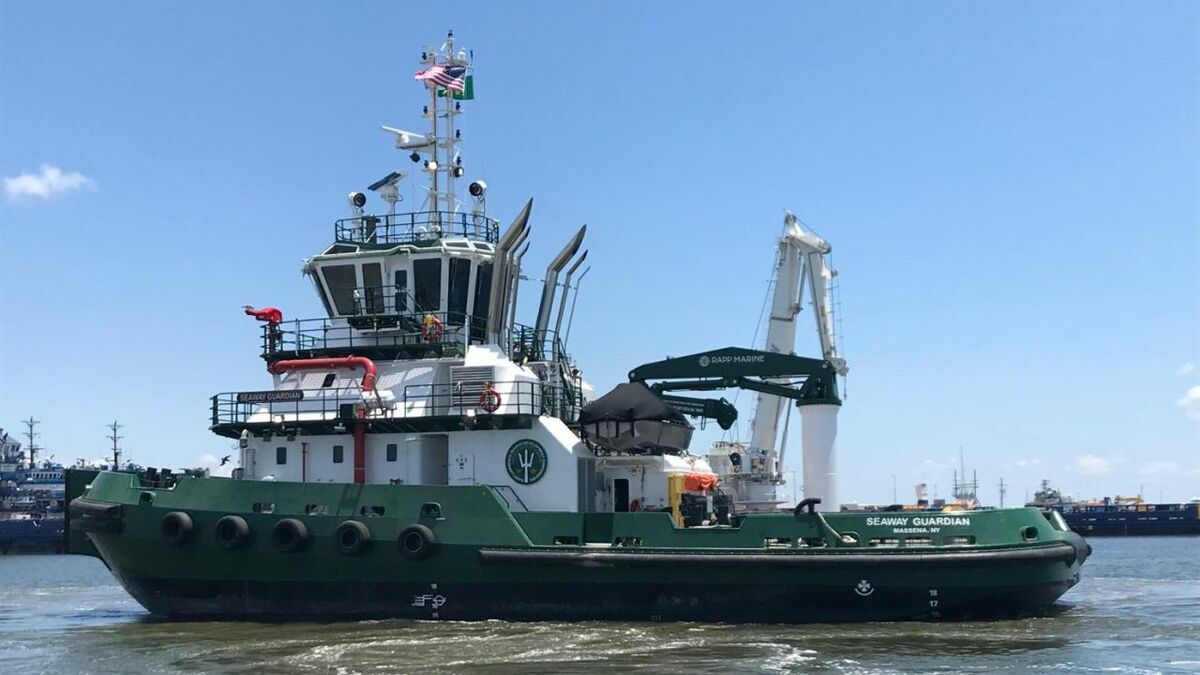
The Saint Lawrence Seaway is the navigation corridor that connects the Atlantic Ocean to the Great Lakes through a series of locks, canals, and channels along the U.S.–Canada border. The U.S. side of the seaway is maintained by the Saint Lawrence Seaway Development Corporation (SLSDC), a federal entity inside the U.S. Department of Transportation. SLSDC’s job, in plain terms, is to keep the seaway open and safe for the commercial traffic that moves American grain, ore, and manufactured goods to and from world markets.
That work happens on the water, year-round, in some of the harshest inland-marine conditions in North America. And in 2019, SLSDC took delivery of a new tugboat, the Seaway Guardian, built at Gulf Island Shipyards in Houma, Louisiana, and delivered north on a three-week passage around Florida and up the Atlantic seaboard. She was the first new American-built tugboat to join SLSDC in 61 years.
We outfitted her marine heating package.
What an ice-class tug actually does
The Seaway Guardian is a Robert Allan Ltd. TundRA 3600 design, purpose-engineered for ice work. SLSDC’s missions for the vessel are buoy maintenance, ice management, firefighting support, and emergency operational response across the seaway. That mission profile means the boat works in conditions that recreational craft don’t:
- Lake-effect winters with sustained sub-freezing air temperatures
- Spray that turns to ice on impact with the deck and superstructure
- Crews handling buoys, lines, and firefighting equipment with gloved hands on surfaces that need to stay clear of ice
- Long duty cycles where the vessel may be hours from the nearest dock
A working tug in those conditions doesn’t have the option to wait for warmer weather. The crew goes when the call goes.
Crew comfort on a federal work boat isn’t a luxury. It’s whether the line gets handled, the buoy gets pulled, the call gets answered.
Where the heat goes
Our scope on the Seaway Guardian covers the working surfaces and the systems that have to stay functional in the cold:
- Decks: self-regulating heating panels under the working surfaces, tuned for ice-clearance watt density
- Hatch drains: preventing ice plugs that would otherwise back water into spaces that need to drain
- Fire stations: keeping the supply ready and the connections accessible at any temperature
- Pipes: heat tracing on the runs that would freeze in a Lake Superior January
The element is self-regulating polymer at the material level. It draws current proportional to local temperature and tapers off automatically as the surface warms. There’s no thermostat to fail open and no relay to weld closed. On a federal vessel where the unattended-failure cost is measured in mission downtime (not just discomfort), that material-level safety margin is the part the procurement team cares about.
Why this work matters to us
Federal marine work has a different acceptance posture than commercial. The specifications are exhaustive, the documentation requirements are real, and the supplier you pick is the supplier you live with through years of vessel-life. SLSDC chose Gulf Island as the builder. Gulf Island specified our marine heating. The vessel went into service in 2019 and has been working the seaway through the winters since.
When prospective buyers in the federal and municipal marine space ask whether our system can handle a serious work-boat environment, the Seaway Guardian is one of the references we point to. A new American-built tug, in U.S. DOT service, working the U.S.–Canada border in genuine winter conditions. That’s the operating profile our marine heating was designed for.




Leave A Comment