
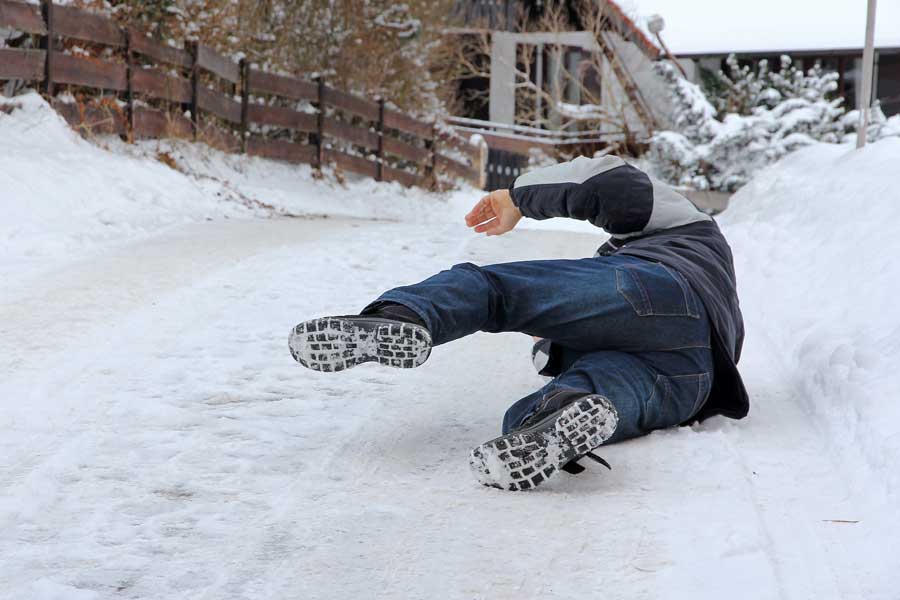
Why slope changes the design
A flat driveway needs enough watts per square foot to melt snow as it falls and clear the surface in a reasonable window. A sloped driveway needs the same thing, plus a few additional considerations:
- Higher watt density. Snow on a slope is harder to clear because meltwater runs off before it can finish the work. We typically spec the watt density up by 10–25 percent on graded drives, depending on the angle.
- Sensor placement at the high end. The snow sensor goes at the top of the drive: the spot that sees weather first and stays coldest longest. A sensor at the bottom can be sheltered by the structure or warmed by ambient drift, both of which delay activation.
- Element layout that accounts for water travel. As elements melt snow into water, that water moves downhill. The lower zones may need slightly tighter element spacing to handle both the falling snow and the runoff arriving from above.
- Edge zones that don’t get neglected. The shoulders of a sloped drive often see more snow accumulation than the center because of plow drift from the road. The element layout has to extend to the actual width of risk, not just the visible tire path.
There is no recovery move when the drive points downhill at the road.
What changes at altitude
Elevation in the literal sense (the project’s altitude above sea level) affects the system in two ways. Storms at higher elevation tend to be colder and drier, which actually makes snowmelt work better per watt because the elements aren’t fighting wet, heavy snow at marginal temperatures. But the design temperature for the controller has to reflect the actual climate zone, not a regional average pulled from sea-level data. We spec to the worst-case storm temperature the property has historically seen, not the climatology textbook number for the nearest weather station 2,000 feet lower.
That’s a small distinction that matters. A controller tuned to the wrong design temperature either runs constantly when it doesn’t need to (waste) or fails to start when it should (failure mode). The Elevation install was tuned to the elevation, not the zip code.
What the homeowner asked for
The conversation that drove this project was straightforward. The homeowner had spent enough winters watching cars slide on the drive (their own and the delivery truck’s and the visiting family’s) that they’d reached a decision point. The choices were: install snowmelt, move, or accept that some mornings the driveway just wasn’t usable.
Snowmelt was the cheapest of those three options by a wide margin.
The takeaway for steep-grade homeowners
If your driveway has a meaningful slope and you live somewhere it snows, the calculation is different than it is for a flat suburban drive. The risk profile is higher, the watt density needs to be higher, and the consequences of an iced surface are categorically worse. We don’t pitch snowmelt as the answer for every driveway. For a steep grade in a snow climate, we pitch it as the answer.
Validate that with the install drawings and the climate-zone math. The Elevation project did. The result is a driveway that clears itself when the storm comes, and a homeowner who doesn’t think about the grade in February.




Leave A Comment